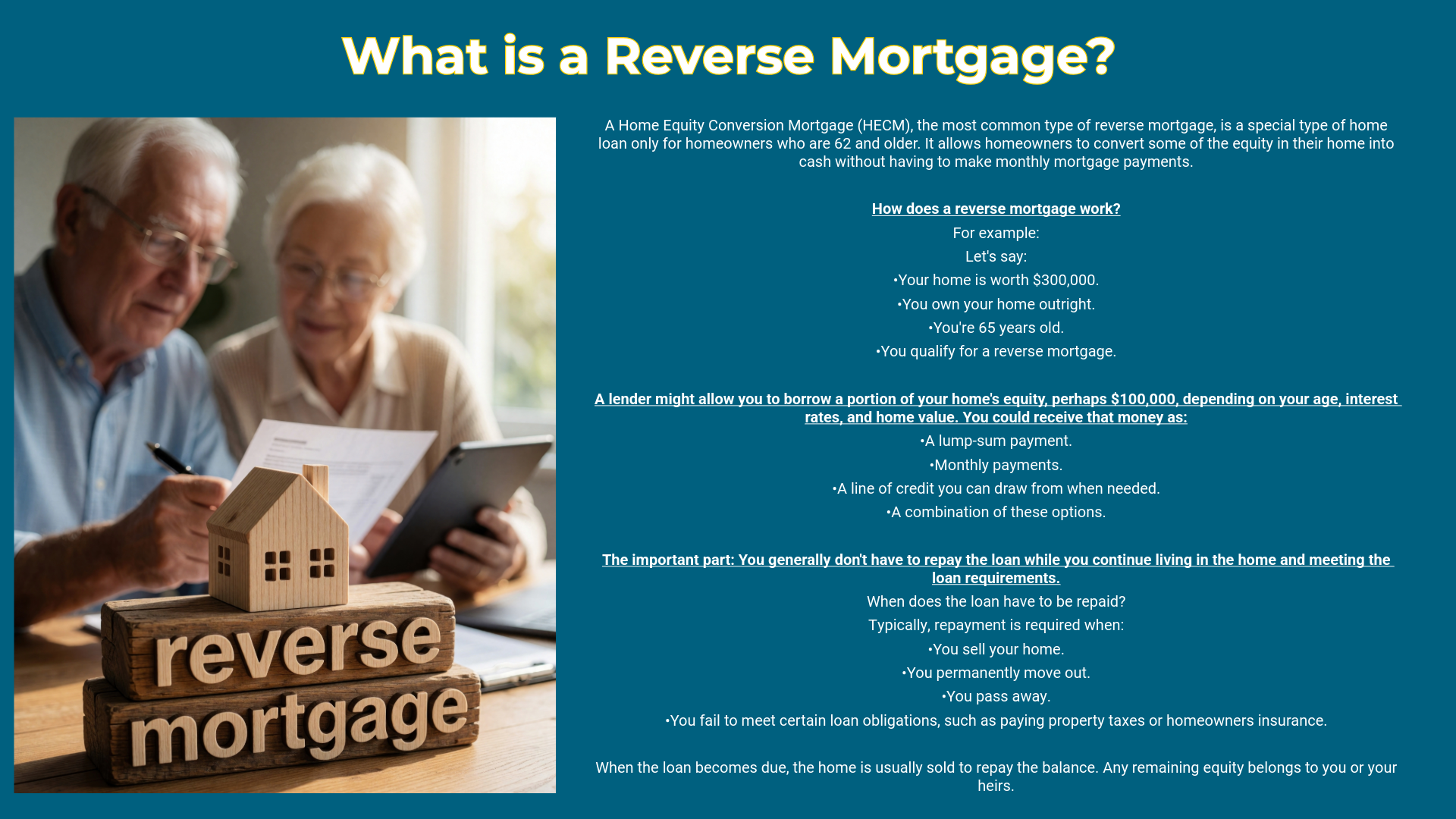
A reverse mortgage is a type of home loan that allows homeowners, usually age 62 or older, to convert some of the equity in their home into cash without having to make monthly mortgage payments.
Instead of you paying the lender every month, the lender pays you (or makes money available to you) using the equity you've built up in your home.
How does a reverse mortgage work?
For example:
Let's say:
- Your home is worth $300,000.
- You own your home outright.
- You're 65 years old.
- You qualify for a reverse mortgage.
A lender might allow you to borrow a portion of your home's equity, perhaps $100,000, depending on your age, interest rates, and home value.
You could receive that money as:
- A lump-sum payment.
- Monthly payments.
- A line of credit you can draw from when needed.
- A combination of these options.
The important part: You generally don't have to repay the loan while you continue living in the home and meeting the loan requirements.
When does the loan have to be repaid?
Typically, repayment is required when:
- You sell your home.
- You permanently move out.
- You pass away.
- You fail to meet certain loan obligations, such as paying property taxes or homeowners insurance.
When the loan becomes due, the home is usually sold to repay the balance.
Any remaining equity belongs to you or your heirs.
Advantages of a reverse mortgage
- You can access money without selling your home.
- No required monthly mortgage payments.
- You can use the money for living expenses, medical bills, or retirement.
- You can continue living in your home.
- The money received from a federally insured reverse mortgage generally isn't considered taxable income.
Disadvantages of a reverse mortgage
- Interest and fees accumulate over time.
- Your home equity decreases.
- Your heirs may inherit less money.
- You must continue paying property taxes, homeowners’ insurance, and maintenance costs.
- If you move out permanently, the loan generally becomes due.
An important protection
The most common reverse mortgage in the United States is called a HECM (Home Equity Conversion Mortgage). It is insured by the FHA.
HECM loans generally have non-recourse protection: neither you nor your heirs will owe more than the home's value when the loan is repaid, provided the loan requirements are met.
Is a reverse mortgage a good idea?
It can be helpful for someone who:
- Is 62 or older.
- Wants to remain in their home.
- Has substantial home equity.
- Needs additional retirement income.
- Doesn't want to make monthly mortgage payments.
However, it isn't right for everyone, particularly if you plan to leave your home to your children or move in the near future.