The stock market is a system where people buy and sell ownership shares of public companies on a marketplace called an exchange. When you own a share of a company, you own a small piece of that business.
Why do companies sell stock?
Companies sell stock to raise money for things like:
- Expanding operations
- Developing new products
- Hiring employees
- Paying off debt
For example, when a company goes public through an Initial Public Offering (IPO), it offers shares to investors in exchange for capital.
How does the stock market work?
Stock exchanges
- Regulated by the Securities and Exchange Commission in the United States.
- Ensure fair and transparent transactions.
- Enforce listing standards and regulatory compliance.
Companies issue shares
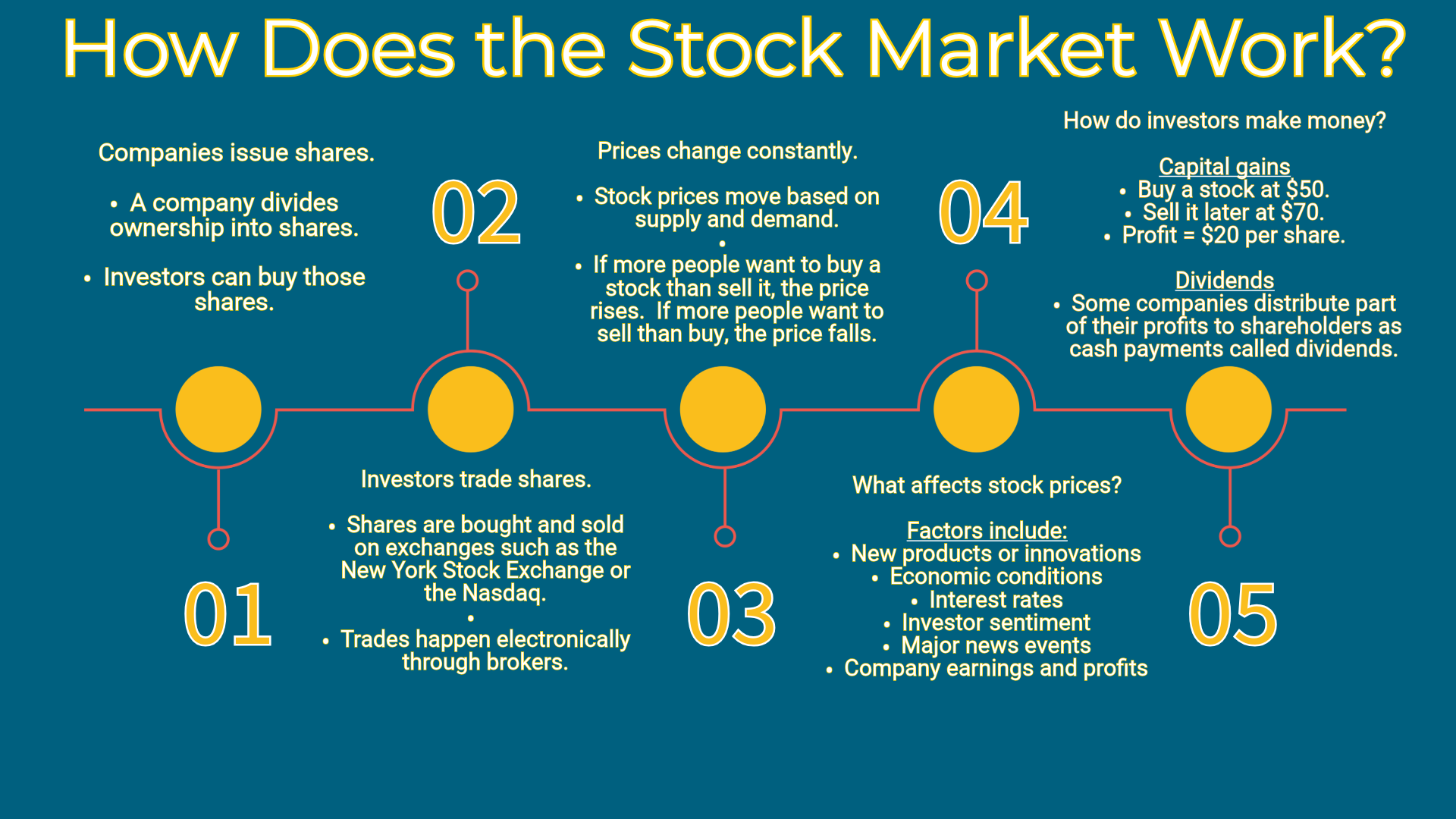
- A company divides ownership into shares.
- Investors can buy those shares.
Investors trade shares
- Shares are bought and sold on exchanges such as the New York Stock Exchange or the Nasdaq.
- Investors use an intermediary called a broker to make the trades on the exchange.
- Investors can buy shares directly from the company in an IPO or trade existing shares with other investors.
Prices change constantly
- Stock prices move based on supply and demand.
- If more people want to buy a stock than sell it, the price rises.
- If more people want to sell than buy, the price falls.
What affects stock prices?
Factors include:
- Company earnings and profits
- New products or innovations
- Economic conditions
- Interest rates
- Investor sentiment
- Major news events
For example, if a company reports stronger-than-expected profits, investors may rush to buy its stock, causing the price to rise.
How do investors make money?
Capital gains
- Buy a stock at $50.
- Sell it later at $70.
- Profit = $20 per share less any transaction fees.
Dividends
- Some companies distribute part of their profits to shareholders as cash payments called dividends.
Losses
- Investors lose money when stocks sell at a lower price than their purchase price.
- Investors may incur transaction fees when buying or selling stocks.
Who participates in the stock market?
- Individual investors
- Mutual funds
- Pension funds
- Hedge funds
- Banks
- Insurance companies
A simple example:
Imagine a company is worth $1 million and divides ownership into 100,000 shares.
- Each share is worth $10.
- You buy 100 shares for $1,000.
- If the company grows and each share rises to $15, your investment becomes worth $1,500.
Why is the stock market important?
The stock market:
- Helps businesses raise money.
- Gives investors a way to build wealth.
- Reflects expectations about the economy.
- Supports economic growth by directing capital to companies.
- Stocks can be easily bought or sold in the market, giving investors flexibility to access funds when needed.
A useful way to think about it: the stock market is a marketplace where ownership in businesses is bought and sold, and prices change based on what investors believe those businesses will be worth in the future.